

Are you looking for the best speech therapist in Greater Noida for your child? Have you noticed that your child is not speaking clearly, has difficulty expressing their needs, or struggles to communicate with others?
Finding the right speech therapist is an important step towards supporting your child’s communication development. Whether your child has a speech delay, language difficulties, stammering or pronunciation problems, professional guidance can help you understand their needs and explore suitable therapy options.
However, with different therapy centres and professionals available, parents may find it difficult to decide where to begin.
In this guide, we will explain what to look for when choosing a speech therapist, what questions to ask before booking an appointment and where parents in Greater Noida can enquire about speech and language therapy.
Why Does Choosing the Right Speech Therapist Matter?
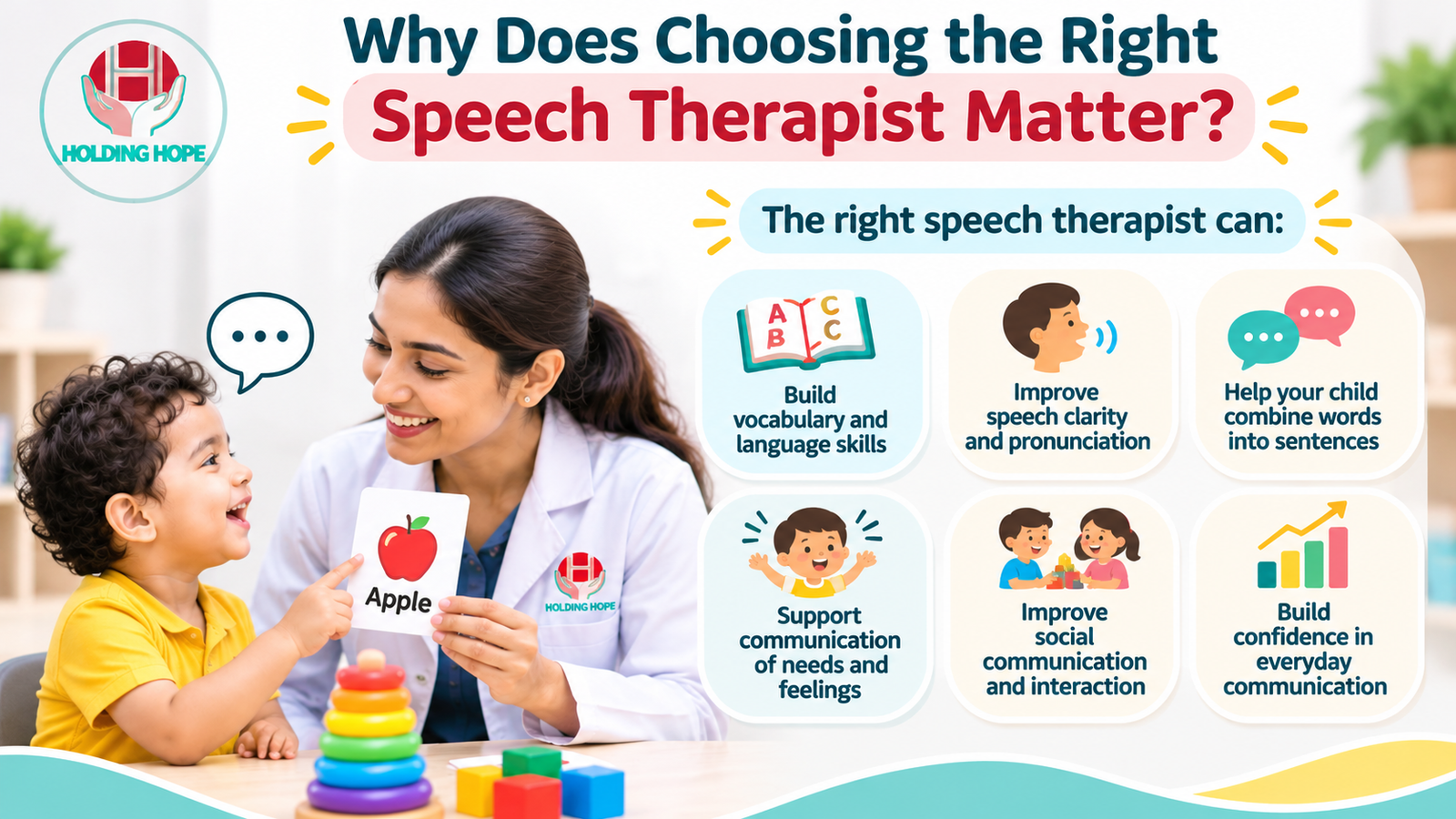
Every child develops communication skills differently. Some children may have difficulty saying words clearly, while others may struggle to understand instructions, form sentences or express their thoughts.
A qualified speech-language professional can assess your child’s communication abilities and identify areas where support may be helpful.
The right therapy approach can help children work towards:
Developing vocabulary and language skills.
Improving pronunciation and speech clarity.
Learning to combine words into sentences.
Communicating their needs and feelings.
Improving social communication and interaction.Developing confidence in everyday communication.
Speech therapy is not the same for every child. Therapy goals should be based on an individual assessment and the child’s communication needs.
7 Things to Check Before Choosing a Speech Therapist in Greater Noida
Before selecting a speech therapy centre, consider the following points.
1. Check the Therapist's Qualifications and Registration
One of the first things parents should check is the professional qualification of the speech therapist.
In India, look for a recognised qualification in Audiology and Speech-Language Pathology, such as BASLP or MASLP, as applicable.
You should also ask whether the professional has valid registration with the Rehabilitation Council of India (RCI), where required.
2. Look for Relevant Clinical Experience
Experience matters because communication difficulties can vary from one child to another.
For example, a child with a speech delay may need a different therapy approach from a child who stammers or has difficulty pronouncing certain sounds.
Ask whether the therapist has experience working with children who have concerns such as:
Speech and language delay.
Pronunciation and articulation difficulties.
Stammering or stuttering.
Language development difficulties.
Communication difficulties associated with autism.
Social communication challenges.
A therapist should be able to explain their experience and the type of support they provide.
3. Make Sure Your Child Receives an Individual Assessment
A good speech therapy process should begin with understanding your child’s communication abilities.
During an assessment, the professional may observe:
How your child communicates.
How many meaningful words your child uses.
Whether your child understands simple instructions.
How your child uses gestures.
How your child interacts during play.
Whether hearing assessment or further evaluation may be needed.
An assessment helps the therapist understand your child’s strengths and areas that may need support.
4. Understand the Therapy Approach
Speech therapy should be suitable for your child’s age, interests and communication needs.
For young children, therapy may include:
Play-based communication activities.
Picture books and storytelling.
Interactive games.
Vocabulary-building activities.
Sound and pronunciation practice.
Activities that encourage social communication.
Ask the therapist how sessions are planned and how activities are adapted to your child’s needs.
5. Look for Parent Involvement and Guidance
Parents play an important role in supporting communication development.
A speech therapist should guide parents on how to encourage communication during everyday activities at home.
For example, parents may learn to:
Talk about everyday activities.
Read picture books together.
Encourage simple conversations.
Offer choices to help children communicate.
Expand the words their child uses.
Make playtime interactive.
When parents understand how to support communication outside therapy sessions, they can create more opportunities for their child to practise everyday communication.
6. Ask How Progress Is Monitored
Before starting therapy, ask how the professional will monitor your child’s progress.
You may want to understand:
What communication goals will be set?
How will progress be reviewed?
How often will parents receive feedback?
Will therapy goals change as the child develops?
Every child progresses at their own pace. A professional should explain progress honestly rather than promise a fixed result within a specific number of sessions.
7. Consider the Centre's Location and Convenience
Regular therapy sessions may require planning around your child’s daily routine, school and family commitments.
When choosing a speech therapy centre in Greater Noida, consider:
Distance from your home.
Availability of appointment timings.
Accessibility of the centre.
Clean and child-friendly surroundings.
Communication with parents.
Convenience of follow-up sessions.
Choosing a centre that is practical to visit can make it easier to maintain consistency.
Where Can You Find Speech Therapy in Greater Noida?

If you are searching for a speech therapist in Greater Noida, you can explore qualified professionals and speech therapy centres in your area.
One option for parents to enquire about is The Holding Hope Centre for Speech & Hearing, located in Omicron I, Greater Noida.
The centre provides speech and language therapy services for children and adults, with support for communication concerns such as:
Speech and language delays.
Vocabulary and language development difficulties.
Pronunciation and articulation difficulties.
Stammering and fluency concerns.
Communication difficulties associated with autism.
Adult speech and communication difficulties.
The focus is on understanding each individual’s communication needs and identifying appropriate therapy goals.
Parents can contact the centre to discuss their child’s concerns, enquire about an assessment and understand the available therapy options.
Why Consider The Holding Hope Centre for Speech & Hearing?
At The Holding Hope, we understand that every child has a different way of learning and communicating.
Our aim is to provide a supportive environment where children and families can receive guidance about speech, language and communication development.
The centre is located at:
The Holding Hope Centre for Speech & Hearing
C-210, Omicron I, Greater Noida, Mathurapur, Uttar Pradesh – 201310.
Parents can visit the website to learn more about the centre and its services:
The Holding Hope Centre for Speech & Hearing
You can also visit the Contact Us page to enquire about appointments.
